When most travellers picture a Moroccan desert, they picture the Sahara: those classic golden dunes that have appeared in every car commercial since the 1970s. But thirty kilometres southwest of Marrakech sits something quieter, stranger, and — for many visitors with limited time — honestly better: a vast rocky desert known locally as Agafay, and increasingly internationally as the stone desert near Marrakech. This guide tells you what it is, why it matters, and how to actually experience it without making the mistakes most first-timers make.
The stone desert near Marrakech is the Agafay Desert, a hammada-type rocky desert located 30 km southwest of the city (45-minute drive). Unlike the Sahara's soft dunes, Agafay has compact rocky terrain with dramatic ridges facing the High Atlas Mountains. Best activities: quad biking from €40, sunset camel rides from €35, luxury day experiences from €120, glamping overnight from €220. Best time: October-April, golden hour at 4-6 PM. Bookable directly with local operators like Aziz Agafay Desert via WhatsApp.
What is the Stone Desert Near Marrakech?
The stone desert near Marrakech is technically called the Agafay Desert (sometimes spelled Agafy or Agaffay), a vast arid expanse covering roughly 12,000 hectares between Marrakech and the foothills of the High Atlas Mountains. To the geologists, it is a hammada — a rocky plateau formed by millions of years of erosion of ancient sedimentary stone, polished by wind and what little rain falls each year.
To everyone else, it looks like cinnamon-coloured hills folding into each other under an impossibly blue sky. Dry riverbeds called oueds snake through the landscape, occasionally lined with the twisted silhouettes of acacia trees. To the south-east, the jagged peaks of the Atlas rise sharply, dusted with snow from December through March. To the north-west, the artificial Lake Takerkoust glints turquoise — locals call it the Marrakech sea.
Why It's Called a Stone Desert
"Stone desert" is the most accurate translation of the geological term hammada. The surface of Agafay is made of compact gravel, clay, and small rocks pressed together over millennia. There are patches of sandy ground in low areas, but they are minimal. You will not see tall sand dunes here. What you will see is rolling rocky hills, dramatic ravines, panoramic ridges, and the surreal contrast of arid land against snow-capped mountains.
Why International Travellers Discovered It
A decade ago, almost no foreign tourists came to Agafay. The Sahara to the south-east was the only "real desert" people knew, and reaching it meant a two-day round trip from Marrakech with overnight stops. Then around 2018-2019, a handful of luxury camps opened in Agafay — La Pause first, then Inara, Scarabeo, Terre des Étoiles — and travel magazines started writing about a new Moroccan desert experience that fit into a single day from Marrakech.
By 2022, Vogue and Condé Nast Traveler had published photo essays about Agafay's "lunar landscape." By 2024, Instagram and TikTok had turned it into one of the most-photographed locations in Morocco. By 2026, "stone desert Marrakech" has become a top-trending search term for travellers planning trips that combine the city, the Atlas mountains, and a desert experience — without giving up half their vacation to driving.
Stone Desert vs Sand Desert: Why It Matters for Your Trip
First-time visitors often assume "desert" means dunes. It doesn't. Most of the world's deserts are actually rocky or gravelly, with sand deserts being a minority of total desert area on Earth. Understanding this distinction matters because it determines which Moroccan desert is right for your trip.
The honest summary: they are complementary, not competing. If you have 5+ days in Morocco, you can do both — Agafay as a day trip, Merzouga as a separate overland expedition. If you have 3 days or fewer, stay with the stone desert near Marrakech and skip the long Sahara drive.
The Best Stone Desert Tours from Marrakech in 2026
A genuine local operator should be able to tell you honestly which package suits which traveller. Below are the experiences we run most often, ranked by which delivers the most value to the broadest range of guests. Prices are direct-to-operator — booking platforms typically add 25-35% commission.
Pool Day VIP Agafay
The flagship stone desert experience. Full day at a private luxury camp with infinity pool overlooking the Atlas Mountains, 1 hour of quad biking, 45-minute sunset camel ride, traditional three-course Moroccan lunch, lounge access. The most complete way to see Agafay in a single day.
Quad + Sunset Camel Combo
Chosen by 4 out of 10 guests. One hour of quad biking on Agafay's varied rocky terrain, followed by a one-hour sunset camel ride as the desert turns golden. The pacing contrast — machine to ancient animal — makes this combo unforgettable.
Sunset Camel Ride
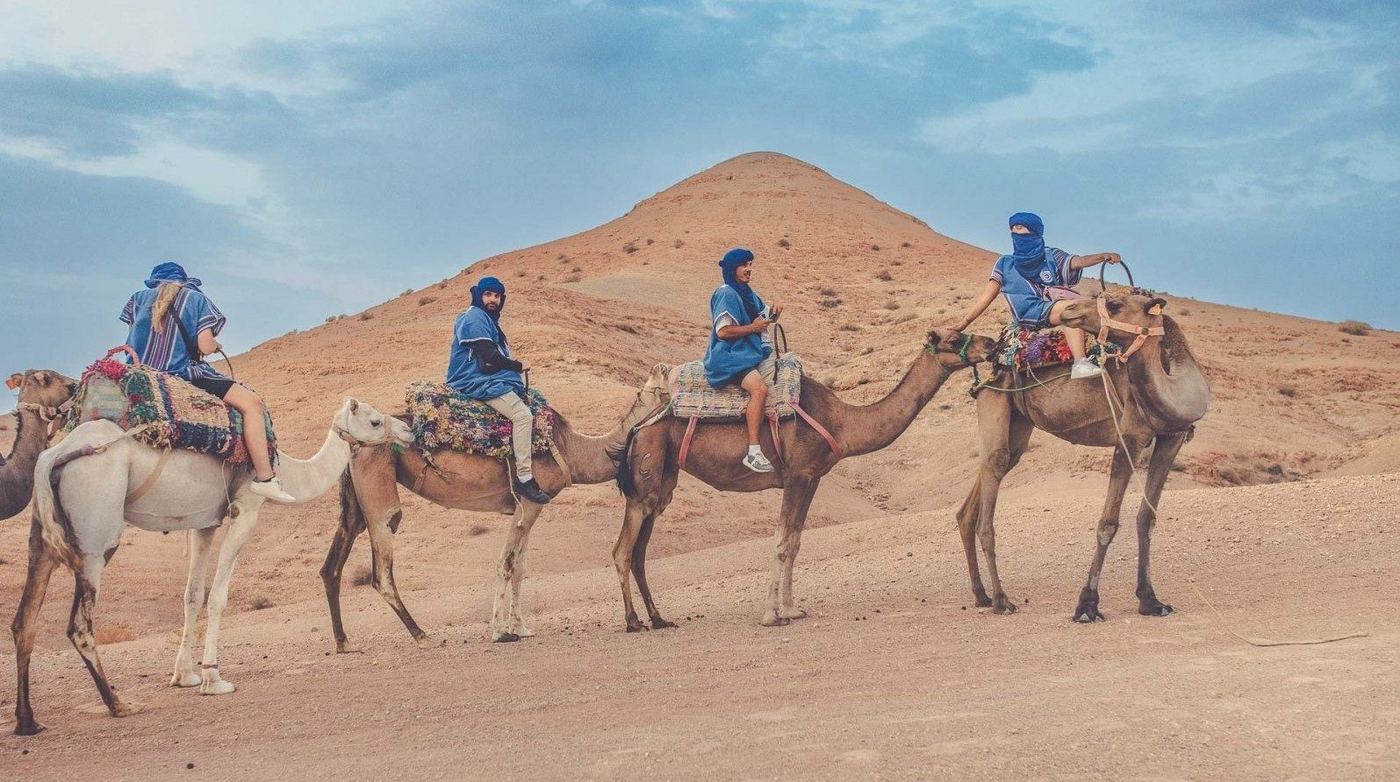
The gentlest stone desert experience and best value. One-hour camel ride at golden hour with a Berber guide and a stop for mint tea. Children from 4 years old can ride safely with a parent. Ideal for couples and travellers wanting a contemplative experience.
Quad Biking 1h
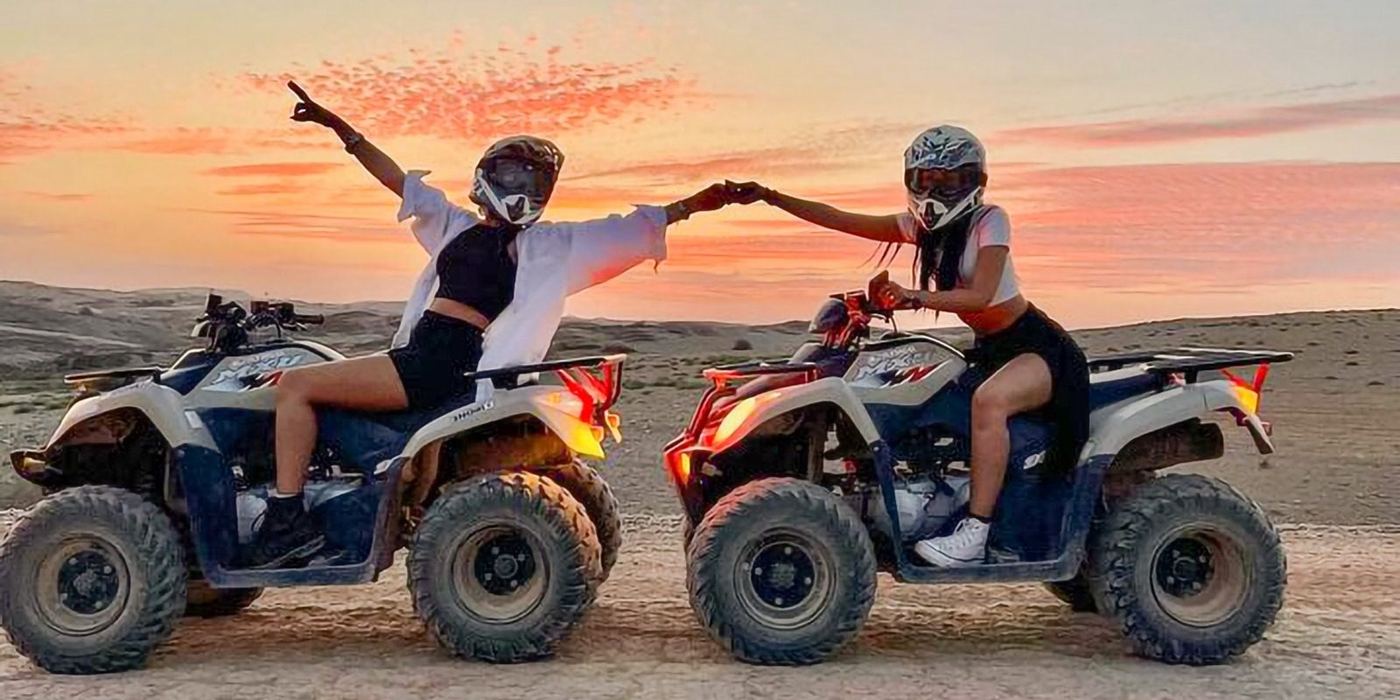
The essential stone desert action experience. Automatic quads, full safety briefing, expert guide riding alongside. Route climbs through dry oueds to a panoramic ridge with Atlas and Lake Takerkoust views before descending back with a mint tea stop.
Buggy Adventure
Side-by-side buggies for 2 people, 1h30 of serious off-road across rugged Agafay tracks. More powerful and faster than quads, perfect for couples or friends who want a real adventure ride together. Requires a valid car driving licence.
Quad + Berber Dinner
Quad in the late afternoon, then dinner under a nomad tent with gnaoua musicians, campfire, and a traditional three-course Moroccan meal. Return to Marrakech around 11 PM. The full immersion package for travellers who want a complete evening in the desert.
Direct booking, no commission, confirmation in under 30 minutes. Free cancellation 24h before. Hotel pickup always included.
Reserve via WhatsAppThe Luxury Camps That Made Agafay Famous
The boom in international interest for the Agafay stone desert can be traced to a wave of luxury glamping camps that opened between 2014 and 2022. These are not the basic Berber tents of older Sahara tours; they are tented suites with king beds, en-suite bathrooms, three-course dinners and stargazing terraces. Below are the camps locals recommend most often.
La Pause Marrakech
The original Agafay luxury escape, opened 2008. Olive groves, traditional Moroccan tents, no electricity in the rooms (light from candles and oil lamps), excellent restaurant focused on local seasonal cuisine. Best for travellers seeking quiet authenticity rather than Instagram glamour. Day pass available for non-overnight guests.
Inara Camp
More design-forward, with cream canvas tents on raised platforms and a famous infinity pool overlooking the desert. Popular with couples and influencer travellers. Three-course dinners served under the stars. Pricing from €280-380 per couple per night depending on season.
Scarabeo Camp
The most "vintage safari" of the Agafay camps, with khaki canvas tents, brass fittings and a colonial-era aesthetic. Smaller scale (around 12 tents) and more intimate. Located on the most photogenic ridge in the area. Pricing from €320-450.
Terre des Étoiles
Eco-luxury, family-friendly, with a focus on sustainable practices. Larger camp with more activity options on-site (small pool, kids' areas, yoga). Better for multi-generational travel groups.
One night is usually enough at any Agafay luxury camp. Two nights start to feel slow because the activities are the same. If you want overnight stays paired with full activity days, the smart play is one night glamping plus a separate Pool Day VIP day-trip the next morning. Total cost roughly €350-450 per couple for a complete two-day stone desert experience.
The Best Time to Visit the Stone Desert
Most visitors book mid-day tours because that's what fits between breakfast at the riad and shopping in the souk. Then they spend an hour squinting at flat white light and wonder why their photos look ordinary. The truth: the Agafay stone desert only becomes Agafay during the golden hour.
By Time of Day
- Early morning (9:00–11:00 AM): Cool temperatures even in summer, crystal-clear visibility on the Atlas, soft eastern light. Best for photography and families with children.
- Late afternoon (4:00–6:00 PM winter / 5:00–7:00 PM summer): The legendary golden hour. Hills shift from beige to copper to amber to pink in under 30 minutes. Atlas mountains light up against navy sky. When professional travel photographers come.
- Avoid 11 AM – 3 PM: Flat midday light kills photo quality. Hot in summer. Not the experience travel magazines write about.
By Month
- October to April — perfect window. Daytime 18-26 °C, crisp air, snow on the Atlas from December to March. High season for a reason.
- May & September — still excellent. Warmer (27-33 °C) but very dry. Book early morning or sunset slots.
- June to August — manageable with adjustments. Midday can hit 38-42 °C. We only operate before 11 AM and after 5 PM in summer, never in the heat.
What to Wear, Bring, and Expect
What to Wear
- Long pants (jeans work well for quad/buggy tours)
- Closed shoes — sneakers or light boots, never sandals
- Long-sleeved top, even in summer (sun protection)
- Scarf or buff to cover face against dust
- Sunglasses + serious sunscreen
- Light layer for evening dinner shows — the desert cools quickly after sunset
What Reputable Operators Provide Free
- Certified helmets (DOT/ECE rated, cleaned between guests)
- Anti-dust goggles
- Gloves on request
- Bottled water during tours
- Authentic Moroccan mint tea
- Photos taken on your phone by your guide
Safety — Honestly
Quad and buggy biking in Agafay are statistically safer than driving a scooter in Marrakech traffic, provided three conditions are met: automatic transmission machines, an expert guide riding alongside on a motorbike (not in a separate vehicle ahead), and a proper 15-20 minute pre-ride briefing covering throttle, brakes and hand signals. After 14 years and over 8,000 guests, Aziz Agafay Desert has recorded zero serious accidents. Choose operators that explicitly meet these three conditions.
Hotel Pickup — Always Included
Every legitimate Agafay stone desert tour should include round-trip hotel pickup from anywhere in Marrakech (Medina, Gueliz, Hivernage, Palmeraie, Agdal) at no extra cost. If an "operator" asks you to make your own way to the desert, that's a red flag — you shouldn't be navigating Moroccan back roads in a rental car at sunset.
Moroccan Hospitality — What It Actually Looks Like
Authentic Moroccan hospitality in the desert isn't a "performance." It looks like this: when you arrive at our base camp, fresh mint tea is poured immediately, before any paperwork or transactions. The guide greets you by name (we know who you are because we read your booking message carefully). Mid-tour, the photo stops aren't rushed; the guide will wait for you to settle into a moment before lifting your phone. At the end, you're offered Berber pastries, and the goodbye is a handshake or a hand on the heart, not a "please leave a 5-star review" reminder. That's the real thing.
Hidden Local Spots Most Tour Operators Never Mention
After fourteen years operating tours in the same fifteen-kilometre stretch of Agafay, you start noticing things tourists never see. Here are six insider locations — the ones I genuinely share with my own friends when they visit.
1. The Sidi Brahim Ridge at 5:30 PM
Most quad tours stop at one or two photo viewpoints. Few include the ridge near Sidi Brahim — the highest point in our zone — with the full Atlas range visible to the east and Lake Takerkoust glittering to the north. We include it on the standard route, but you can request a longer stop if photography is your priority.
2. Lake Takerkoust from the South Side
Most operators approach Takerkoust from the busier east side where tourist boats and lakeside cafes cluster. The southern approach via Agafay is dramatically quieter and offers a much better viewing angle with the stone desert and lake in the same frame.
3. The Salt Flats After Spring Rain (Mar-Apr Only)
In March and April after the rare spring rains, a series of small salt flats appear in low-lying areas. They reflect the sky like mirrors for about three weeks before drying back to clay. Most tours skip them because they require a 15-minute detour. They are worth it.
4. The Old Berber Village Near Tameslouht
A tiny village 6 km from our base camp where my own family has lived for generations. We don't include it on standard tours (we won't turn neighbours' homes into tourist attractions), but on private tours, if you're respectful, we'll stop there for tea with a local family. No performance, no commerce, no Instagram trail.
5. The Acacia Grove on Full Moon Nights
For private sunset tours running into the evening, a small grove of ancient acacias catches the moonlight in a particular way. Magical for photography — silhouettes against a lit desert floor. Only worth it on full moon nights, obviously.
6. Brahim's Brother's Tea Shop
Our guide Brahim's brother runs a tiny tea stall at the edge of a village near the desert. Not a tourist stop — just locals stopping for tea between farm work. Free, no commission, no commerce. We bring guests there when there's time and they want something real.
The single best photo spot in Agafay is a small unnamed ridge 1.8 km from our camp, facing west-northwest. We call it "the second ridge." Mention it when booking a private tour and we'll route through it during golden hour. About 80% of our 5-star Instagram reviews are photographed from this spot.
The Culture Around the Stone Desert
The stone desert isn't just landscape — it has a culture, shaped by the Berber villages that have lived on its edges for centuries. Understanding a little of this culture makes the visit dramatically richer.
The Villages
My own village, Tameslouht, sits 12 km from Agafay's edge. Like most villages in the region, it is predominantly Berber (Amazigh) rather than Arab — a distinction that matters. Berbers were the original inhabitants of North Africa before the Arab conquests of the 7th century, and the Berber languages (Tachelhit in our area) are still spoken in homes. Most people are trilingual: Berber at home, Arabic at the market, French (and increasingly English) for tourism.
Tea Culture
If you take only one cultural lesson from your stone desert visit, let it be this: Moroccan mint tea is not a beverage; it is a ritual. The pouring height matters (the higher the pour, the more respect shown). Three glasses are traditionally served, each with a saying: "The first is bitter like life, the second strong like love, the third gentle like death." Drinking just one is acceptable; declining all three risks being rude. When in doubt, accept.
Hospitality Codes
Moroccan rural hospitality has codes worth understanding. When invited into a home, accept whatever is offered — even if you're not thirsty. Wait to be seated before sitting. Eat with the right hand (the left is considered unclean by tradition). Compliments on the food are expected. Don't admire a specific object too loudly — by old custom, your host may feel obligated to give it to you.
Why Booking Locally Matters Culturally
When you book via a platform like Viator or GetYourGuide, 25-35% of what you pay goes to a Silicon Valley intermediary. When you book directly with a local operator like us, that money stays in the community — funding the maintenance of our quads, the wages of our local guides, and the families of the village. It's not just better value; it's better for the place you came to see.
How to Choose the Best Tour Company
There are roughly 200 listings for "Agafay tours" online today. Maybe 25 of those operators actually have their own land, equipment and guides; the rest are resellers taking a margin without ever visiting the desert. Here is the seven-point checklist I'd use if I were a tourist choosing among them.
- Genuine local roots. Operators should have founders or guides born in the Agafay region — not Marrakech-based subcontractors. Ask about their personal connection to the desert.
- Verifiable reviews above 4.8/5. With hundreds of recent reviews, not 12 from 2018. Look at Google reviews directly, not just curated testimonials.
- Transparent all-inclusive pricing. Hotel transfer, equipment, guide and tea should be in the headline price. Hidden fuel supplements or insurance fees added later are red flags.
- Modern, well-maintained equipment. Ask how often quads and buggies are serviced. The honest answer is weekly.
- Free hotel pickup included. Non-negotiable.
- Small group sizes. Maximum 8 quads per guide. Big "caravans" of 14-20 quads mean less attention and worse safety.
- Free cancellation 24h before. Confident operators offer this.
If you'd rather skip the research entirely, we'd be honoured to host you. Message us directly on WhatsApp with your dates and group size; we respond within 30 minutes with options and a no-obligation quote.
Stone Desert Marrakech — FAQ
The stone desert near Marrakech is the Agafay Desert, located 30 km southwest of Marrakech, near Lake Takerkoust. Unlike the Sahara, Agafay is composed of compact rocky and gravelly terrain with rolling beige hills, dramatic ravines, dry riverbeds and panoramic ridges facing the snow-capped High Atlas Mountains. It is sometimes called the Marrakech Desert and is the closest desert experience to the city, accessible in just 45 minutes of driving.
Agafay is called a stone desert because its surface is made of compact gravel, clay and rock formations rather than soft sand dunes. Geologically, it is a hammada-type desert, a rocky plateau shaped over millions of years by erosion of ancient sedimentary rock from the High Atlas. This is fundamentally different from the dune desert (erg) you find in Merzouga, where wind-deposited sand forms tall mobile dunes.
The Agafay stone desert is approximately 30 km southwest of central Marrakech. Driving time is about 45 minutes via the Route de Guemassa, mostly on smooth tarmac road. From any Marrakech hotel (Medina, Gueliz, Hivernage, Palmeraie, Agdal), hotel pickup is included in all Aziz Agafay Desert tours at no extra cost.
A stone desert (hammada) has a surface of compact rocks, gravel and clay with sparse vegetation, like Agafay near Marrakech. A sand desert (erg) has wind-deposited soft sand forming dunes that can reach 150 metres high, like Merzouga's Erg Chebbi or the Algerian Sahara. Stone deserts are more varied for activities like quad biking; sand deserts are more iconic for camel treks and overnight desert camps.
Yes, the Agafay stone desert is absolutely worth visiting, especially if you have limited time in Morocco. Just 45 minutes from Marrakech, it offers dramatic desert landscapes, panoramic Atlas mountain views, authentic Berber experiences, luxury camps and varied activities (quad biking, camel rides, dinner shows, infinity pools), all accessible as a half-day or full-day trip from Marrakech without needing the 2-day Sahara expedition.
Top activities in the Agafay stone desert include: quad biking on rocky terrain from 39 EUR, sunset camel rides from 29 EUR, luxury full-day experiences with infinity pool, quad, camel and lunch from 120 EUR, buggy adventures for 2 from 150 EUR, traditional Berber dinner shows under nomad tents from 59 EUR, glamping overnight stays from 220 EUR, and private photography or proposal tours.
Yes, the Agafay stone desert is safe to visit with a reputable local operator. Quad and buggy tours include automatic transmission, full safety briefing, helmets, and an expert guide riding alongside the group. After 14 years and over 8,000 guests, Aziz Agafay Desert has recorded zero serious accidents. Choose operators with verifiable Google reviews above 4.8/5 and well-maintained equipment serviced weekly.
The best months to visit the Agafay stone desert are October to April, with daytime temperatures of 18-26 degrees Celsius and snow on the High Atlas mountains from December to March. The best time of day is the golden hour: 9-11 AM (cool, clear) or 4-6 PM in winter / 5-7 PM in summer (legendary Agafay sunset). Avoid midday tours in June to August when temperatures can reach 40 degrees.
Wear long pants (jeans work well), closed shoes (sneakers or boots, never sandals), a long-sleeved top even in summer, sunglasses, sunscreen, and bring a scarf to cover your face against dust. For quad or buggy tours, helmets and goggles are provided free. The desert is warm during the day but cools quickly after sunset, so bring a light layer for evening dinner shows.
Choose Agafay if you have 1-3 days in Marrakech, want activity variety (quad, buggy, camel, luxury pools), prefer rocky panoramic landscapes, or want a luxury day experience. Choose Merzouga if you have 3+ free days and the authentic Saharan dune experience is on your bucket list. They are complementary, not competing. If you have 5+ days in Morocco, do both.
Yes, Agafay has become one of Morocco's premier luxury desert camp destinations. Notable camps include La Pause, Inara Camp, Scarabeo Camp, and Terre des Étoiles, offering tented suites with king beds, private bathrooms, three-course dinners and stargazing. Day-use luxury experiences like the Aziz Agafay Desert Pool Day VIP (120 EUR) provide the same atmosphere without overnight stays. Pricing for overnight glamping ranges from 220 to 450 EUR per couple per night.
Stone desert tour prices from Marrakech in 2026 range from 29 to 450 EUR per person. Budget options: camel ride 29 EUR, quad 1h 39 EUR. Mid-range: combo packages 59 EUR. Luxury day: Pool Day VIP 120 EUR. Overnight glamping: 220-450 EUR per couple. All Aziz Agafay Desert tours include round-trip hotel pickup and direct booking via WhatsApp avoids the 25-35% commission added by Viator or GetYourGuide platforms.
Book direct with the desert.
Real local pricing, no platform commission, confirmation in under 30 minutes — directly with Aziz, born and raised on the edge of the Agafay stone desert. Free cancellation 24h before, hotel pickup always included.
Or call directly: +212 725 598 343